Contents:
1. How to Evaluate Solar Panel Cleaning Equipment in 2026
1.1 System size and site type (residential, rooftop C&I, utility-scale)
1.2 Climate, soiling profile, and water availability
1.3 Safety, standards, and warranty compatibility
1.4 Automation level and labor constraints
1.5 Total cost of ownership (TCO) and ROI
2. Best Solar Panel Cleaning Solutions for Residential & Small Commercial Systems
2.1 Integrated manual cleaning kits (brush + pole + squeegee)
2.2 Water-fed pole and brush systems with pure water filtration
2.3 Lightweight electric / powered brush kits
3. Best Equipment for Large Commercial & Industrial Rooftops
3.1 Professional-grade water-fed pole systems and pure water plants
3.2 Semi-automated crawler and rail-mounted robots
3.3 When to outsource vs. invest in your own fleet
4. Best Solutions for Utility-Scale Solar Farms
4.1 Fully autonomous dry-cleaning robotic systems
4.2 Water-based robotic solutions for high-soiling, non-arid regions
4.3 Data, connectivity, and integration with O&M platforms
1. How to Evaluate Solar Panel Cleaning Equipment in 2026
As module prices keep falling and installed capacity keeps rising, the economics of solar are increasingly decided after commissioning. A clean module surface is now one of the most controllable levers you have to protect yield, stabilize performance ratios, and meet contractual guarantees. The question is no longer “Do I need cleaning equipment?” but “What is the right level of equipment and automation for my site conditions and business model?”
Evaluating solar panel cleaning equipment in 2026 means looking beyond the marketing labels and working systematically through five dimensions: system size and site type, climate and soiling, safety and warranty, automation and labor, and total cost of ownership (TCO) and ROI.
1.1 System size and site type (residential, rooftop C&I, utility-scale)
The starting point is simple: what kind of asset are you cleaning, and how big is it?
For a small residential system—perhaps a 5–20 kW roof—the cleaning solution can be lightweight, highly portable, and designed for intermittent use by non-professionals. A basic manual kit, possibly enhanced with pure water, will usually suffice, because the absolute area is modest and cleaning frequency is low. Overspecifying equipment here leads to a payback period that never closes.
On the other end of the spectrum, a 50 MW desert plant cannot be maintained with ladders and hand brushes. The sheer area, repetitive geometry, and often harsh environment naturally push you toward semi- or fully automated solutions: robotic crawlers, rail systems, or autonomous fleets. Between these extremes lie large commercial and industrial (C&I) rooftops, which typically favor professional-grade water-fed pole systems and, in some cases, semi-automated robots that can operate safely on flat roof surfaces.
A useful practical rule:
-
Under ~500 kW (mostly residential/small commercial): focus on simple, flexible, low-capex solutions.
-
~500 kW–10 MW (large rooftops, small ground-mount): efficiency and repeatability become more important; consider semi-automated tools.
-
>10 MW (utility scale): no serious strategy avoids some form of automation.
1.2 Climate, soiling profile, and water availability
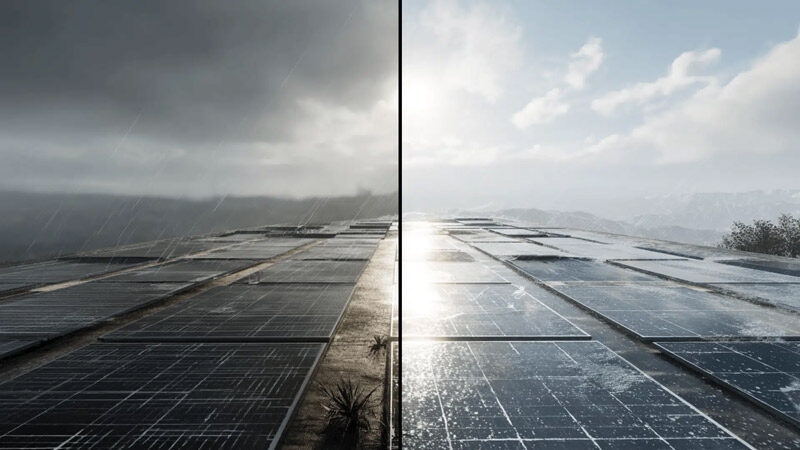
Climate and soiling are the physics behind your cleaning strategy. Ignoring them is the fastest way to buy the wrong equipment.
In arid or semi-arid regions, fine dust can settle daily, causing performance losses long before surfaces look visibly dirty. Rainfall is infrequent and often too light to remove adherent dust. Under these conditions, dry-cleaning robots or low-water systems can be attractive, especially when plants are remote and water logistics are expensive.
In humid, agricultural, or coastal environments, soiling is different. Panels accumulate sticky contaminants—bird droppings, pollen, salt, industrial fallout—that bond strongly to glass. Here, water-based cleaning with decent flow and, preferably, pure or low-TDS water is crucial to avoid streaks and mineral deposits. Water quality becomes as important as water quantity; high-hardness or high-TDS water, when sprayed and left to dry, can permanently mark the glass surface.
Water availability is often the hard constraint. Some sites have ample municipal water; others rely on trucked supply or on-site treatment. When you evaluate equipment, you should explicitly ask:
-
How many liters per kW (or per MW) does this solution consume per cleaning cycle?
-
What is the required inlet water quality, and what filtration or RO/DI capacity is included or needed?
-
Is the system capable of operating in “water-stressed” mode (reduced flow, recirculation, or dry cleaning) if needed?
Only after you understand how fast you soil, what type of soiling you get, and how much water you realistically have does it make sense to choose between purely manual, water-fed, or robotic solutions.
1.3 Safety, standards, and warranty compatibility
From a risk perspective, cleaning is one of the more hazardous O&M activities: it combines work at height, water, and live DC systems. In 2026, insurers, lenders, and module manufacturers expect coherent safety management, not improvised solutions.
On rooftops, you must consider fall protection, edge protection, and safe access routes as part of your equipment decision. A highly productive powered brush system is worthless if operators are improvising their footing on sloped tiles or standing on module frames. For ground-mount systems, electrical safety dominates: avoiding direct spraying at junction boxes and connectors, respecting voltage limits for wet conditions, and ensuring that robots do not damage cables or earthing systems.
Warranty compatibility is equally important. Virtually all module manufacturers prohibit:
-
Abrasive pads or brushes that can scratch glass or anti-reflective coatings.
-
Very high-pressure jets close to the surface.
-
Aggressive chemicals (solvents, strong alkalis/acids) unless expressly approved.
When evaluating cleaning equipment, verify that brush materials, contact pressure, and any recommended chemicals are compatible with the brands deployed on your site. A minor increase in cleaning speed is never worth jeopardizing product warranties across megawatts of installed capacity.
1.4 Automation level and labor constraints
Automation is not an end in itself; it is a response to labor economics and operational risk.
If you operate a small portfolio of residential systems, local labor may be relatively easy to schedule, and cleaning frequency is low. Here, full automation is overkill: a simple, well-designed manual or semi-manual toolset plus basic training delivers the best cost–benefit ratio.
For large C&I rooftops, the calculus changes. Manually brushing thousands of modules is both slow and physically demanding. Semi-automated tools—powered brushes, high-capacity water-fed systems, and roof-safe robots—can dramatically improve the area cleaned per technician per day, reducing both fatigue and unit labor cost. In many markets, this is where the first meaningful automation ROI appears.
Utility-scale plants are the natural home of full automation: autonomous robots, robotic arms, or vehicles that traverse rows systematically. The question you must answer is:
“Given my soiling rate and performance targets, how many cleanings per year do I need, and can I reliably deliver them with human crews alone?”
If the honest answer is “no,” you should stop thinking in terms of tools and start thinking in terms of cleaning capacity—how many megawatts per day your fleet (people plus machines) can realistically handle.
1.5 Total cost of ownership (TCO) and ROI
The final step is to translate technical choices into economics. A purely up-front price comparison is misleading; you need to evaluate the full TCO:
-
Capex: purchase price of equipment, shipping, installation, any structural modifications (rails, docks, power feeds).
-
Opex: labor, water, energy, filters, replacement brushes, spare parts, consumables, and periodic servicing.
-
Performance benefit: recovered energy yield vs. a baseline of no or minimal cleaning.
-
Risk and lifetime impact: potential reduction in glass damage, hotspot formation, or other failures due to proper cleaning.
A simple approach is to model two scenarios over one or more years—with and without systematic cleaning—and compare:
- Annual energy yield, based on soiling loss assumptions and cleaned vs. uncleaned intervals.
- Total annual cleaning cost (labor + water + equipment amortization).
If the value of incremental energy yield substantially exceeds cleaning costs and payback on equipment is within your target horizon (often 2–5 years for professional operators), the investment is typically justified. For very small sites, this math may favor periodic manual cleaning or even outsourced service rather than owning specialized equipment.
2. Best Solar Panel Cleaning Solutions for Residential & Small Commercial Systems
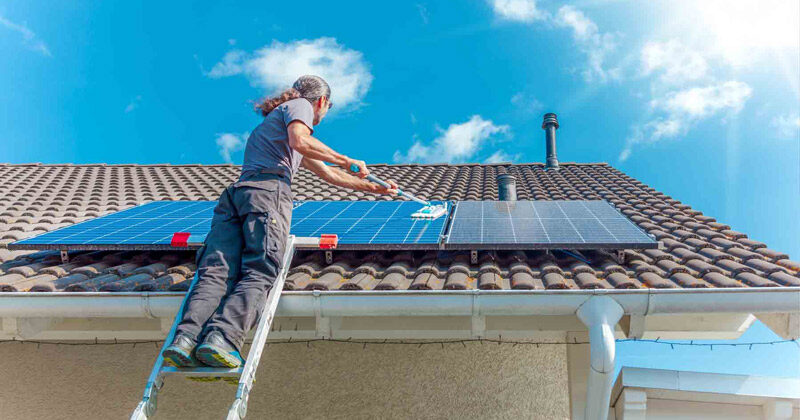
Residential and small commercial systems demand simplicity, safety, and affordability. The owner or a small local contractor often performs the cleaning, so the equipment must be intuitive and forgiving. Yet, it still needs to meet professional standards to avoid damaging modules.
2.1 Integrated manual cleaning kits (brush + pole + squeegee)
These kits are the entry point for most small systems. A typical kit includes a lightweight telescopic pole, a soft brush head tailored for glass, and a squeegee or microfiber pad for finishing.
Used correctly, such kits provide a safe way to dislodge loose dust, pollen, and light grime. They are particularly suitable for single-story houses, carports, and small commercial roofs where a single operator can reach most modules from a ladder or from the ground. The main trade-off is time and physical effort: as the array grows beyond a few dozen modules, manual brushing becomes tiring and may limit cleaning frequency.
For households and small businesses that treat cleaning as an annual or semi-annual maintenance task, integrated manual kits offer a solid compromise between cost and outcome, especially when combined with access to reasonably clean water.
2.2 Water-fed pole and brush systems with pure water filtration
A step up in sophistication is the water-fed pole system connected to a pure water source (often RO/DI). Here, water is pumped through the pole and exits at the brush head, allowing the operator to wet, scrub, and rinse in one motion.
The addition of pure water changes the game for regions with hard or mineral-rich water. Because dissolved solids have been removed, the water dries without leaving white spots or streaks, eliminating the need for manual drying and reducing the risk of long-term staining. This is particularly beneficial for glass surfaces exposed to strong sunlight, where residues can “bake” into the surface over time.
For residential and small commercial owners who are quality-conscious or who operate in regions with challenging water chemistry, investing in a compact pure water system plus water-fed poles can dramatically improve both aesthetics and performance. The equipment is still portable and manageable by small crews, yet it brings a level of consistency closer to professional service.
2.3 Lightweight electric / powered brush kits
Where system sizes are larger or roofs are more complex, powered brushes mounted on poles or small frames can offer a highly attractive middle ground. Electric motors rotate the brush, reducing the physical work required from the operator and maintaining more consistent contact pressure and cleaning action.
These kits are commonly deployed by local service companies that maintain multiple small sites. Motorization improves productivity per person and can open the door to offering more frequent cleaning without proportionally increasing labor hours. They can be used with or without water, depending on the model and local soiling profile.
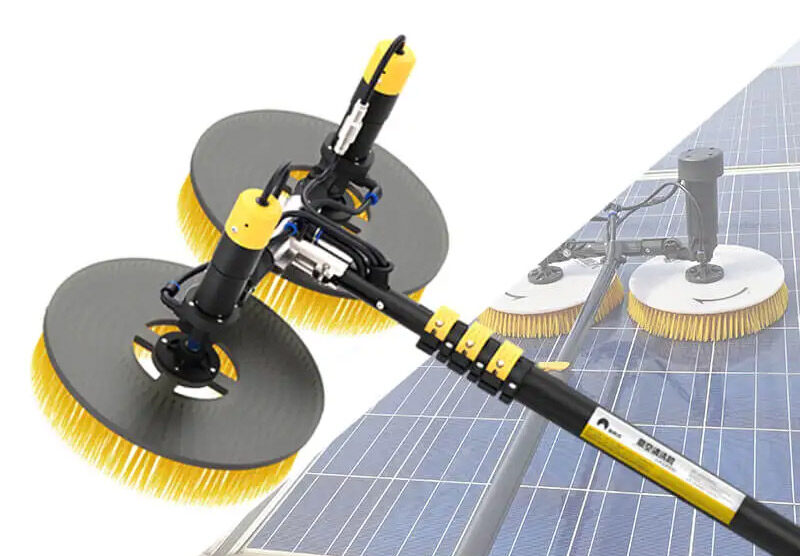
When choosing such equipment, attention should be paid to weight, ergonomics, brush material, and available battery runtime (for cordless variants). A representative example of this class is a dedicated solar panel brush such as the NEEXGENT X41 solar panel cleaning brush, integrated into a broader toolkit with safe access equipment, water management, and personal protective equipment.
See also: Best Solar Panel Cleaning Brush in 2026
3. Best Equipment for Large Commercial & Industrial Rooftops

As system sizes grow into the hundreds of kilowatts or megawatt range on large flat roofs, the cleaning challenge becomes one of logistics and throughput. The priority shifts from “What can one person do?” to “How can a small professional crew maintain a large asset efficiently and safely?”
3.1 Professional-grade water-fed pole systems and pure water plants
In this segment, professional-grade pure water plants paired with robust water-fed poles are often the backbone of cleaning operations. Compared with residential units, these systems deliver higher flow rates, support multiple operators simultaneously, and are built for daily use.
On the roof, teams deploy a combination of standpipes, hoses, and poles to reach different sections in a planned sequence. The key to efficiency is workflow design: minimizing hose drag, avoiding trip hazards, and coordinating workers so that pre-wetting, scrubbing, and rinsing happen smoothly. Over time, crews develop site-specific patterns that reduce the number of roof traverses and optimize staging areas.
For asset owners, the advantages are clear: high cleaning productivity with relatively modest capital investment, and a solution that is flexible enough to address roof geometry changes or system expansions. Because the same mobile plant can serve multiple buildings, service providers can spread capex across a large customer base.
3.2 Semi-automated crawler and rail-mounted robots
On very large, relatively uniform roofs—logistics centers, factories, large retail complexes—semi-automated robots become attractive. Crawler-type robots travel across module surfaces using tracks or wheels while rotating brushes sweep the glass. Rail-based solutions run along fixed rails aligned with rows or roof edges.
These systems reduce the physical burden on workers, who transition from direct manual cleaning to supervisory roles: positioning robots, managing hoses or cables, and monitoring performance. The uniformity of industrial roofs lends itself to repeatable robot paths, and the economics improve as the number of modules per site increases.
However, robots introduce new elements into the risk profile: potential for edge-of-roof incidents, interaction with parapets, compatibility with module clamps and frame geometries, and the need to protect cabling and junction boxes. Careful commissioning and clear operating procedures are essential. The success of such systems often depends as much on change management and training as on the hardware itself.
3.3 When to outsource vs. invest in your own fleet
Large C&I owners face a strategic choice: invest in their own cleaning fleet or contract specialized service providers. The decision typically hinges on:
-
Portfolio size and geographic concentration.
-
Required cleaning frequency based on soiling analysis.
-
Internal capabilities and appetite for managing equipment and staff.
A geographically dispersed portfolio of mid-sized rooftops may be more efficiently served by a seasoned cleaning contractor who brings equipment, staff, and know-how, converting capex into predictable service fees. Conversely, a single large facility or dense cluster of sites can make in-house equipment and teams financially attractive, especially when energy tariffs are high and incremental production has strong value.
In many markets, hybrid models appear: critical or heavily soiled sites are cleaned by in-house teams using owned equipment, while less demanding sites are handled by third parties on a scheduled or on-demand basis. The right answer is rarely purely technical; it is a portfolio-level business decision.
4. Best Solutions for Utility-Scale Solar Farms
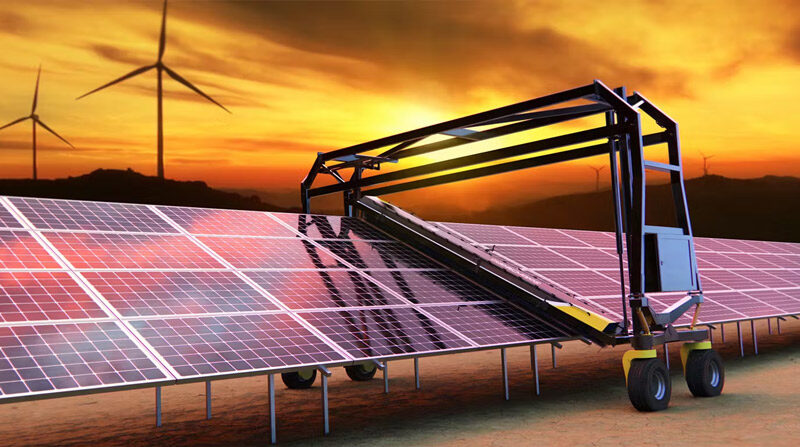
Utility-scale plants present a fundamentally different challenge: very large areas, repetitive layouts, often harsh environments, and strong economic pressure to maximize availability and reduce levelized cost of energy (LCOE). Here, cleaning is an industrial operation, not a simple maintenance task.
4.1 Fully autonomous dry-cleaning robotic systems
In deserts and other water-scarce zones, fully autonomous dry-cleaning robots have become a key technology. These units travel along module rows, typically at night or in low-irradiance windows, using soft dry brushes or microfiber materials to remove dust without water. Many systems return to docking or charging stations at the end of each cycle and may be monitored or scheduled centrally.
The primary virtue of such systems is frequency. Because they require minimal human intervention once deployed, they can clean far more often than manual crews, keeping average soiling losses low even where dust deposition is constant. Over time, this can significantly increase the plant’s net production and improve compliance with performance guarantees.
The trade-offs include high initial investment, engineering work to adapt rows and structures, and ongoing monitoring to detect failures, navigation issues, or abnormal wear. A thorough life-cycle analysis is required, including spare robot provisioning and contingency plans for periods of high wind, sandstorms, or extreme temperatures.
4.2 Water-based robotic solutions for high-soiling, non-arid regions
In non-arid environments where water is more accessible and soiling is sticky or mixed, water-based robots can offer a compelling alternative. These systems combine the consistency and labor savings of robotics with the cleaning power of water and detergent-free pure water rinsing.
Such robots may be rail-mounted, vehicle-mounted, or designed as autonomous units that move along rows while connected to a water hose. They can be particularly effective in large plants near agricultural operations, coastal zones, or industrial regions where particulate matter adheres strongly to modules.
The design challenge is balancing water consumption with logistics. Many operators integrate robots with on-site water treatment and storage, using RO/DI systems to produce pure water at scale and distributing it through dedicated piping. Evaluating these options requires a careful look at pumping energy, filtration maintenance, and potential water reuse options.
4.3 Data, connectivity, and integration with O&M platforms
The most advanced cleaning solutions do not exist in isolation. They integrate into a broader digital O&M ecosystem: SCADA systems, performance monitoring platforms, and CMMS (computerized maintenance management systems).
Robotic fleets may provide:
-
Cleaning logs and coverage maps.
-
Alerts for obstruction, excessive tilt, or suspected panel damage.
-
Interfaces to schedule cleaning in coordination with other maintenance activities or grid dispatch.
From an asset manager’s perspective, this unlocks a more data-driven cleaning strategy. Instead of fixed calendars, operators can trigger cleaning based on measured performance losses, soiling station data, or predictive models that combine weather forecasts and historical behavior. Over time, this can further optimize the trade-off between cleaning cost and performance gain.