Contents:
Bifacial solar panels are becoming more popular among RV owners who want to generate more power from limited roof space. Unlike traditional solar panels, which collect sunlight only from the front side, bifacial panels can capture sunlight from both the front and the back. This design allows them to use direct sunlight as well as reflected light from surfaces such as the RV roof, sand, concrete, gravel, snow, or light-colored ground.
For RV users, this sounds like a major advantage. More solar power can mean longer off-grid stays, less generator use, and better energy independence. However, bifacial solar panels are not automatically the best choice for every RV setup. Their performance depends heavily on installation style, roof surface, travel environment, and budget.
Pros of Bifacial Solar Panels for RVs
1. Higher Energy Production Potential
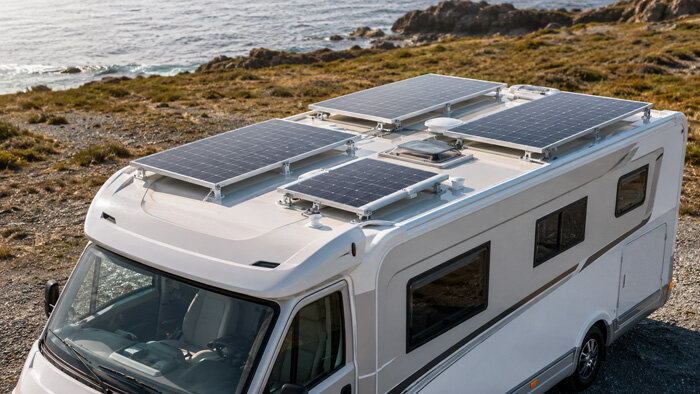
The biggest advantage of bifacial solar panels is their ability to produce extra power from reflected sunlight. In ideal conditions, the rear side of the panel can add a meaningful amount of energy to the total output.
For RV owners with limited roof space, this can be valuable. A motorhome, camper van, or travel trailer often has vents, air conditioners, skylights, antennas, and roof racks that reduce available panel area. If bifacial panels can produce more energy from the same footprint, they may help maximize the system without adding more panels.
2. Better Performance in Reflective Environments
Bifacial panels perform best when there is strong reflected light under or around them. This makes them especially useful in certain RV travel conditions.
For example, camping in snowy areas, deserts, beaches, or open gravel lots can improve rear-side light exposure. Snow is particularly reflective, so winter campers may see better results than they would with traditional panels. Light-colored RV roofs can also help reflect some sunlight toward the back of the panels.
This advantage is less noticeable when the RV is parked over dark soil, grass, asphalt, or shaded ground.
3. Useful for Tilted or Portable Setups
Bifacial panels can be more effective when they are tilted rather than mounted flat against the RV roof. A tilted panel allows more light to reach the back side, which increases the benefit of the bifacial design.
This makes bifacial panels attractive for portable solar setups. If you use foldable or ground-mounted panels while camping, you can position them above reflective surfaces and angle them toward the sun. In this type of setup, bifacial technology may provide more noticeable gains than it would on a flat roof installation.
4. Durable Glass-Glass Construction
Many bifacial solar panels use a glass-glass design, meaning both the front and back sides are protected by glass. This can improve durability and resistance to weather, moisture, and long-term degradation.
For RV use, durability matters. Panels are exposed to vibration, wind, rain, temperature changes, tree branches, and road debris. A strong panel can be a good investment for RV owners who travel often or spend a lot of time outdoors.
However, this benefit also comes with a trade-off: glass-glass panels are often heavier than traditional panels.
5. Better Long-Term Value in the Right Setup
If installed correctly, bifacial panels may deliver better long-term energy production than standard panels. For RVers who rely heavily on solar power, the extra output can reduce generator runtime and improve battery charging during the day.
This is especially useful for people who use power-hungry devices such as induction cooktops, laptops, portable refrigerators, Starlink systems, water pumps, fans, or electric tools. The more energy your RV lifestyle requires, the more valuable extra solar output becomes.
Cons of Bifacial Solar Panels for RVs
1. Limited Benefit on Flat RV Roofs
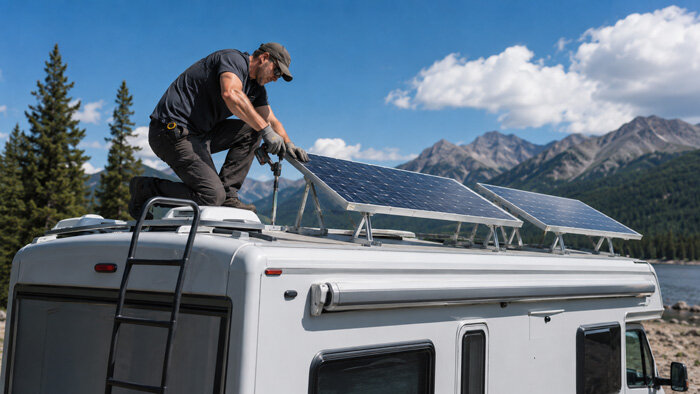
The main drawback is that bifacial panels do not perform at their best when mounted flat and close to the RV roof. If there is very little space between the panel and the roof, not much reflected light can reach the rear side.
Many RV solar systems use low-profile mounts to reduce wind resistance and keep the installation simple. While this works well for traditional panels, it limits the advantage of bifacial panels. In this case, the rear side may contribute only a small amount of additional power.
For many RV owners, a high-quality monofacial panel may offer similar real-world performance at a lower cost.
2. Higher Cost
Bifacial panels are often more expensive than standard solar panels. The higher price may be worth it if your setup allows strong rear-side production, but it may not make sense if the panels are mounted flat on a dark or poorly reflective roof.
Before buying bifacial panels, RV owners should compare the cost per watt and expected real-world output. Paying more for technology that cannot be fully used may reduce the overall value of the system.
3. Heavier Weight
Many bifacial panels, especially glass-glass models, are heavier than traditional flexible or framed solar panels. Weight is an important factor for RVs because every pound affects payload, fuel economy, handling, and roof load.
This is especially important for camper vans, small trailers, truck campers, and older RVs with limited roof strength. Before installing bifacial panels, you should check whether your roof can safely support the added weight, including mounting hardware.
4. More Complex Installation Requirements
To get the most from bifacial panels, installation details matter. The panels need enough space underneath for reflected light to reach the rear surface. A reflective roof surface can also improve performance. In some cases, tilting the panels or using raised mounts may increase energy production.
However, raised or tilted panels can create other problems. They may increase wind resistance while driving, require stronger mounting hardware, and add complexity to the installation. On an RV, solar panels must be secure enough to handle highway speeds, vibration, and changing weather conditions.
This makes bifacial panels less straightforward than standard roof-mounted panels.
5. Performance Gains Are Not Guaranteed
Bifacial solar panels can produce more power, but the extra gain depends on conditions. Shade, dirt, roof color, panel angle, mounting height, and ground reflectivity all affect performance.
If the RV is often parked under trees or in shaded campgrounds, bifacial panels will not solve the problem. Like all solar panels, they still need sunlight. If the rear side is blocked or receives very little reflected light, the advantage becomes small.
This means marketing claims about higher output should be viewed carefully. The real-world benefit on an RV may be lower than the maximum gain advertised by manufacturers.
Are Bifacial Solar Panels Worth It for RVs?
Bifacial solar panels can be worth it for RVs, but only in the right situations. They make the most sense when the panels are portable, tilted, raised above a reflective surface, or installed on a light-colored roof with enough space underneath. They are also a good option for RV owners who frequently camp in open, sunny, reflective environments such as deserts, beaches, snowy areas, or gravel lots.
However, they may not be the best choice for a simple flat roof installation. If the panels are mounted close to the roof and the rear side receives little reflected light, the extra cost and weight may not be justified. In that case, standard high-efficiency monofacial panels may be the more practical option.
Conclusion
Bifacial solar panels offer a real advantage for RV owners who can take advantage of reflected sunlight. Their main benefits include higher potential energy output, strong performance in reflective environments, and durable construction. However, they also come with drawbacks such as higher cost, added weight, more complex installation, and limited gains on flat roof setups.
For RV solar systems, the best choice depends on how and where you camp. If your setup allows light to reach both sides of the panel, bifacial solar panels can improve your off-grid power supply. But if your panels will sit flat against a typical RV roof, traditional solar panels may offer better value and simpler installation.