The transition to decentralized energy has matured significantly over the last half-decade. By 2026, the home battery is no longer a niche luxury for energy enthusiasts; it has become a standard appliance for modern grid resilience. Amidst the various chemistries available, Lithium Iron Phosphate (LiFePO4) has unequivocally established itself as the industry standard for residential storage, pushing Nickel Manganese Cobalt (NMC) to the sidelines due to LFP’s superior thermal stability, safety profile, and extended cycle life.
While the market offers a dizzying array of capacities, the 10kW / 10kWh class remains the "Goldilocks" solution for the average household. It offers enough energy density to weather overnight outages and sufficient continuous power to run heavy loads like HVAC systems and induction cooktops. This article evaluates the top-tier solutions available in 2026, with a specific technical focus on the emerging dominance of modular rack systems like the NEEXGENT NX48200.
The Evolution of Storage: 2026 Market Standards
The battery market of 2026 is defined not just by capacity, but by intelligence and integration. Gone are the days when a battery was simply a passive reservoir of electrons. The leading 10kW systems today are active grid participants. They utilize AI-driven algorithms to predict weather patterns for solar generation, analyze real-time "Time-of-Use" (TOU) utility rates, and automatically arbitrage energy—storing it when it is cheap and discharging it when it is expensive.
Furthermore, the physical architecture of these batteries has bifurcated into two distinct categories: High-Voltage (HV) Series Systems and Low-Voltage (LV) 48V Parallel Systems. While HV systems have gained traction for their efficiency in converting DC to AC, the 48V architecture remains the king of versatility, compatibility, and safety. It is in this robust 48V sector that we see the most significant value propositions for homeowners looking for deep cycle life and easy expandability.
Key Evaluation Criteria
When selecting a 10kW system in the current market, professionals evaluate four critical vectors:
-
Volumetric Energy Density: How much power fits in the footprint?
-
BMS Sophistication: Can the Battery Management System actively balance cells to prevent degradation?
-
Round-Trip Efficiency: The ratio of energy retrieved vs. energy stored (standard is now $>95\%$).
-
Cycle Life: In 2026, the benchmark has moved from 6,000 to nearly 8,000+ cycles at 80% Depth of Discharge (DOD).
Spotlight Review: NEEXGENT NX48200
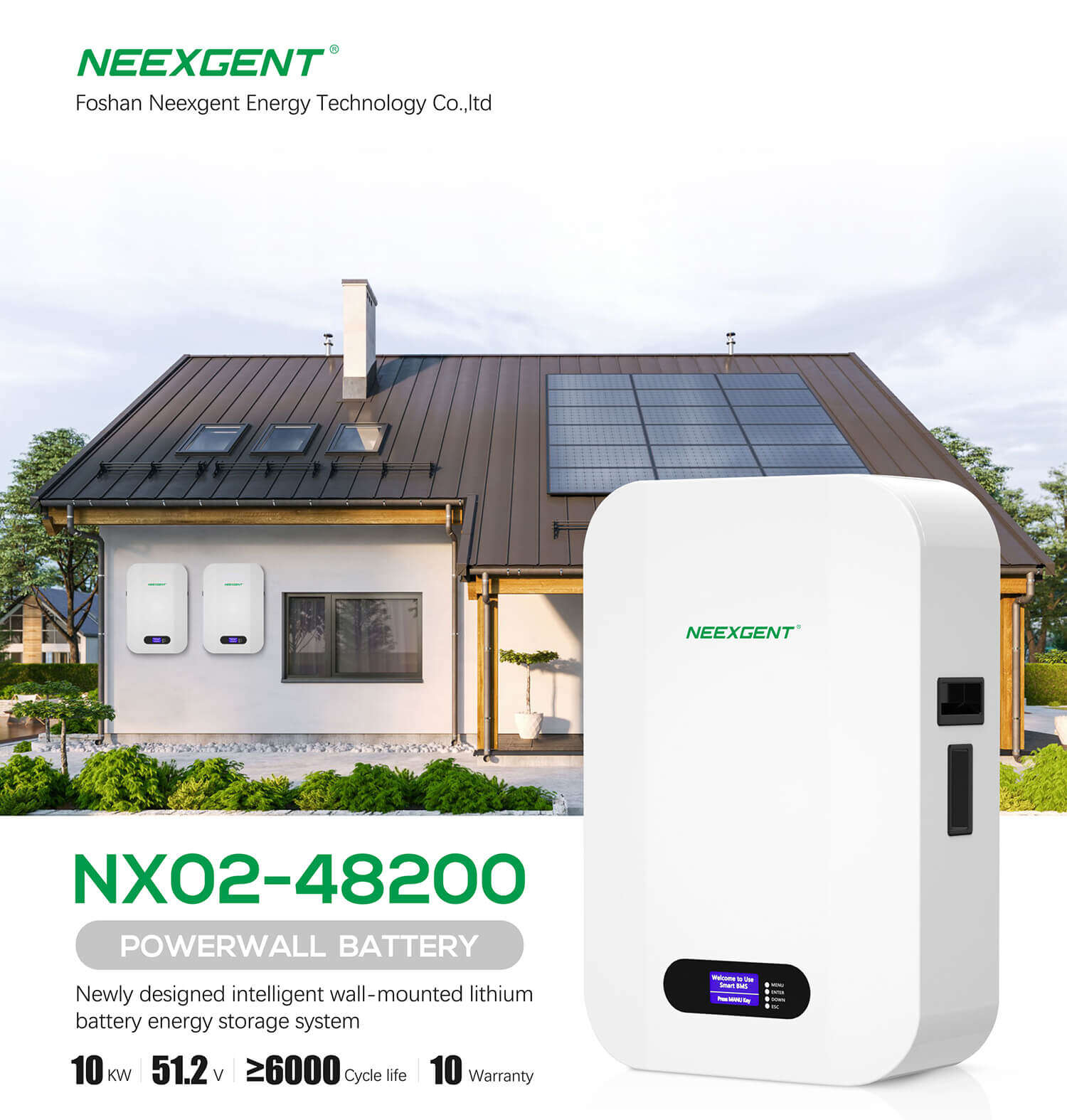
In the crowded field of server-rack and modular batteries, the NEEXGENT NX48200 has emerged as a formidable contender for the best value-for-performance 10kW solution. Unlike competitors that require stacking multiple smaller modules (e.g., two 5kW units) to achieve a 10kWh target, the NX48200 delivers a massive 10.24kWh capacity in a single, robust chassis.
The NX48200 utilizes prismatic LiFePO4 cells, which are structurally superior to cylindrical cells for stationary storage. The system operates at a nominal voltage of 51.2V, the industry sweet spot for 48V inverters. This compatibility is crucial; the NX48200 pairs seamlessly with major inverter brands like Victron, Deye, and Sol-Ark via CAN/RS485 communication protocols, allowing the inverter to read precise State of Charge (SOC) data rather than relying on voltage estimates.
From a thermal management perspective, the unit is designed for passive cooling efficiency. By eliminating active fans in favor of heavy-duty aluminum heat dissipation, NEEXGENT reduces the failure points of the system and ensures silent operation—a critical factor for residential installations.
Technical Highlights of the NX48200:
-
Massive Capacity: A true 200Ah capacity at 51.2V yields $10,240 \text{ Wh}$ (10.24 kWh), effectively serving as a "whole home" backup in a single unit.
-
High Discharge Rate: The system supports high continuous discharge currents, allowing it to handle surges from well pumps or AC units without tripping the BMS protection.
-
Safety Architecture: The built-in BMS monitors individual cell voltages, current, and temperature, providing Tier-1 protection against overcharging, over-discharging, and short circuits.
Comparative Analysis: Top 10kW Systems
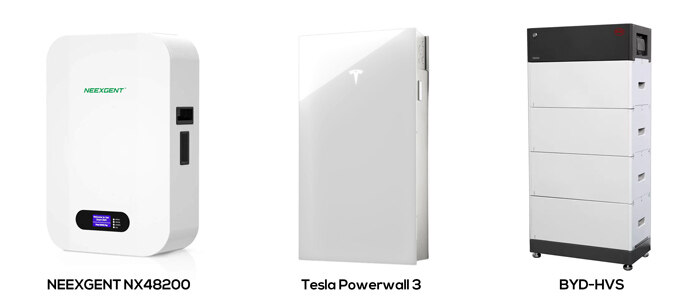
To understand where the NEEXGENT stands, we must compare it against other market archetypes: the Premium All-in-One (typically AC-coupled like the Tesla Powerwall series) and the High-Voltage Stack (like BYD or Sungrow).
The following table breaks down the technical specifications of these competing architectures for 2026.
2026 Strategic Comparison of 10kW Class LiFePO4 Systems
| Feature |
NEEXGENT NX48200 |
Premium AC-Coupled (e.g., Powerwall 3 Type) |
HV Modular Stack (e.g., BYD HVS Type) |
| Architecture |
DC-Coupled (48V Low Voltage) |
AC-Coupled (All-in-One) |
DC-Coupled (High Voltage ~400V) |
| Total Energy |
10.24 kWh (Single Unit) |
13.5 kWh |
10.2 kWh (4 Modules) |
| Chemistry |
LiFePO4 (Prismatic) |
LiFePO4 |
LiFePO4 |
| Scalability |
High (Parallel up to 15+ units) |
Medium (Stack up to 4 units) |
Medium (Series stacking) |
| Round-Trip Efficiency |
≈ 95% (Battery only) |
≈ 90% (AC-to-AC) |
≈ 96% (High Voltage) |
| Inverter Compatibility |
Universal (Victron, Deye, SMA, etc.) |
Closed Ecosystem (Integrated Inverter) |
Brand Specific (Fronius, Kostal, etc.) |
| Cycle Life |
>6,000 cycles @ 80% DOD |
>5,000 cycles |
>6,000 cycles |
| Maintenance |
Low (Modular replacement) |
High (Requires service tech) |
Medium |
| Primary Use Case |
Off-Grid, Hybrid Retrofit, DIY |
Grid-Interactive, Ease of Use |
High-Efficiency Solar Self-Consumption |
The Verdict: Choosing the Right System
The definition of the "best" battery in 2026 depends heavily on the installation context.
For homeowners seeking a "set it and forget it" experience who are willing to pay a premium for software aesthetics, the All-in-One AC-coupled systems remain the leader. They integrate easily into homes that already have solar installed without needing to replace the existing inverter.
However, for those prioritizing energy independence, cost-efficiency, and system flexibility, the NEEXGENT NX48200 represents a superior architectural choice.
Why the Modular 48V Approach Wins
The advantage of the NEEXGENT approach lies in its decoupling of the battery from the inverter. If an integrated All-in-One unit fails, the entire system (battery + inverter) is often out of commission. With the NX48200, the battery is a standalone asset. If you need more capacity in 2028, you simply plug in another 10.24kWh module.
Furthermore, the 10.24kWh form factor is particularly advantageous. In previous years, installers had to wire two 5kWh batteries in parallel to achieve this capacity, which doubled the cabling, doubled the potential points of connection failure, and complicated the BMS communication. By consolidating this into a single 200Ah block, NEEXGENT has simplified the installation process while increasing reliability.
Final Recommendation
If you are designing a robust hybrid or off-grid system in 2026 with a target of 10kW to 20kW of storage:
-
Select the NEEXGENT NX48200 if you want to maximize capacity per dollar and retain the freedom to choose your own inverter hardware (like the powerful Sol-Ark 15k or Victron Quattro).
-
Ensure Proper Sizing: While 10kWh is a great start, calculate your critical loads carefully. The beauty of the NX48200 is that a second unit can be added later to double your runtime to 20.48kWh with minimal labor.
In the rapidly maturing energy landscape of 2026, the shift is away from proprietary, locked-down ecosystems toward open, modular, and repairable standards—a shift that the NX48200 exemplifies perfectly.