A 100 watt solar panel does not produce a fixed voltage at all times. Its voltage depends on the panel design, sunlight intensity, temperature, electrical load, and whether the panel is connected to a battery, charge controller, or other equipment.
For most 100W panels marketed as 12V solar panels, the actual operating voltage is usually around 17 to 20 volts, while the open-circuit voltage commonly falls between 20 and 24 volts. These values are higher than 12V because the panel needs enough voltage to charge a 12V battery effectively through a solar charge controller.
Understanding these voltage ranges makes it easier to choose compatible batteries, controllers, inverters, and wiring configurations.
A common 100W 12V solar panel may have a maximum power voltage, often labeled Vmp, of approximately 18V. This is the voltage measured when the panel is operating near its rated maximum power under standard test conditions.
The same panel may have an open-circuit voltage, labeled Voc, of around 21V to 23V. Voc is measured when the solar panel is exposed to sunlight but is not connected to a load.
These figures explain why a panel described as “12V” normally produces considerably more than 12 volts. The 12V label refers mainly to the type of battery system the panel is designed to support rather than its exact electrical output. A broader look at the typical voltage of solar panels shows how rated system voltage differs from actual operating voltage across different panel sizes and applications.
The specification label on a 100 watt solar panel normally includes several electrical values. The two most useful voltage ratings are:
Maximum Power Voltage (Vmp): Usually around 17–20V for a typical 100W 12V panel. This represents the voltage near the panel's maximum power point.
Open-Circuit Voltage (Voc): Commonly around 20–24V. This is the highest voltage measured when no electrical load is connected.
Nominal Voltage: Often listed as 12V. This describes the battery system the panel is intended to work with rather than the panel's exact output voltage.
Voltage at the Load: The measured voltage can change once the panel is connected to a charge controller, battery, or other device.
These ratings should always be checked on the manufacturer's data sheet because two 100W panels can have slightly different voltage specifications even though their rated power is identical.
A solar panel needs a higher output voltage than the battery it is charging. A nominal 12V lead-acid battery, for example, may require roughly 13.5V to more than 14V during charging. A panel producing exactly 12V would often be unable to provide enough charging voltage once system losses and operating conditions are taken into account.
For this reason, traditional 12V 100W panels are designed with a Vmp around 18V. The charge controller then regulates the panel's electrical output and delivers suitable charging voltage and current to the battery.
Voltage is only one side of the panel's output. Current also changes with operating conditions. A typical 100W panel operating around 18V may deliver approximately 5 to 6 amps near its maximum power point. The relationship is easier to see when looking at how much current a 100W 12V solar panel can produce.
The voltage measured from a solar panel in real-world use will rarely match the data-sheet value perfectly. Several operating conditions affect the reading:
Panel temperature: Solar panel voltage generally decreases as cell temperature rises. A hot panel may therefore show a lower voltage than the same panel on a cool sunny day.
Sunlight conditions: Strong, direct sunlight helps the panel operate close to its expected electrical range, while weak or heavily shaded conditions can reduce usable output.
Electrical load: Open-circuit voltage is higher than the voltage measured while the panel is actively supplying power.
Charge controller behavior: PWM and MPPT charge controllers manage panel voltage differently, so measurements taken at different points in the system may not be identical.
Panel construction: Cell type, cell count, and panel design influence Vmp and Voc.
Voltage alone does not determine how much power a solar panel is producing. Solar power depends on both voltage and current, using the formula:
Watts = Volts × Amps
For example, a 100W solar panel operating at 18V would need to produce about 5.56A to reach its full rated output. At 17V, the required current would rise to approximately 5.88A.
In real conditions, a panel may operate below its 100W rating because sunlight, cell temperature, shading, panel orientation, and electrical losses continually affect its output.
Use the calculator below to enter any two values—watts, volts, or amps—and calculate the remaining value. This makes it easier to compare a panel's measured voltage and current with its expected power output.
When a typical 100W 12V panel is disconnected from the system and tested in good sunlight, a multimeter may show approximately 20–24V DC. This corresponds to its open-circuit voltage.
When the panel is connected and operating under load, the voltage may settle closer to its Vmp, often around 17–20V on the panel side of the charge controller.
A reading somewhat different from these values does not automatically mean the panel is defective. Panel temperature, solar intensity, measurement conditions, and the manufacturer's electrical specifications all influence the result.
For accurate testing, compare the measured Voc with the value printed on the panel label rather than relying on a universal number.
The voltage changes significantly when multiple panels are combined.
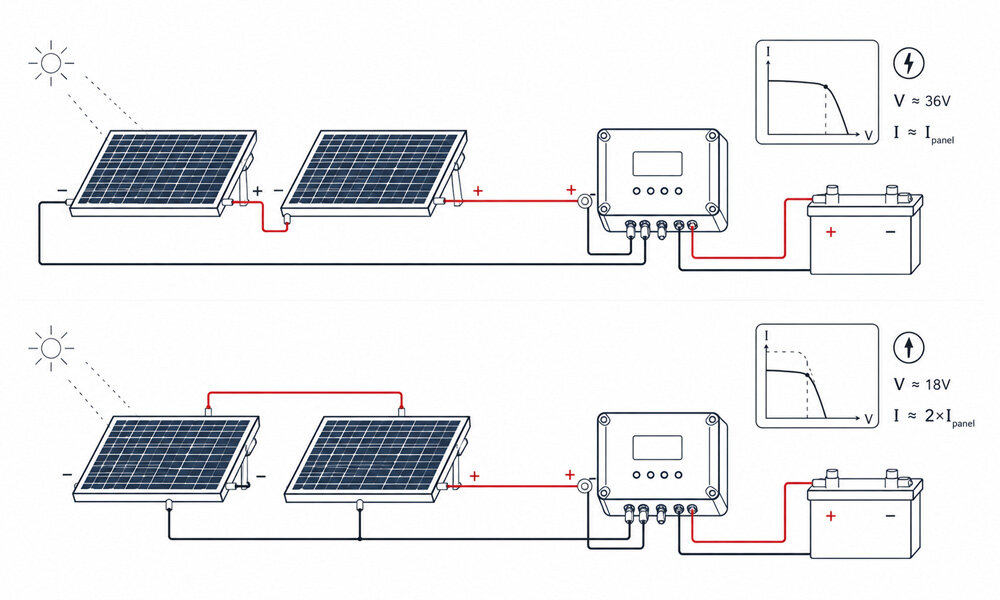
With two similar 100W panels connected in series, their voltages are added while the operating current remains roughly the same. Two panels with an 18V Vmp could therefore create an array operating around 36V.
With the same panels connected in parallel, their voltage stays around 18V while their available current is combined.
This difference affects charge controller selection, cable sizing, and maximum system voltage. The practical behavior of both arrangements is covered in more detail in this guide to solar panels in series vs. parallel configurations.
Panels with the same 100W power rating can have different voltage and current combinations. One model may operate at 18V and higher current, while another may use a higher operating voltage and lower current to reach approximately the same wattage.
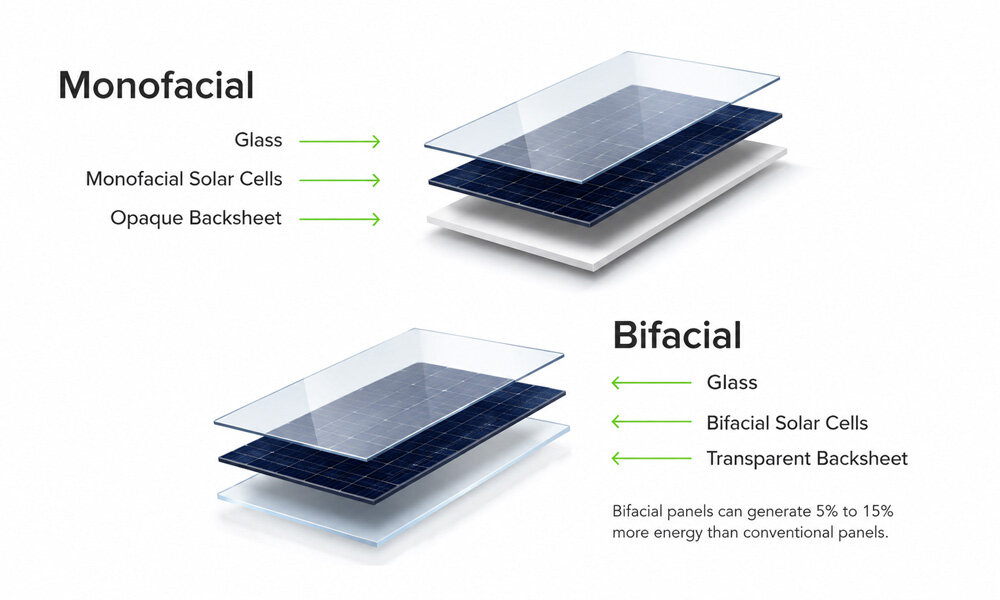
Modern panel construction can vary further with different cell layouts and energy-harvesting designs. For example, the operating purpose and structure of double-sided and single-sided solar panels differ, even though the fundamental relationship between voltage, current, and power remains the same.
This is why wattage alone should not be used to select a charge controller or determine system compatibility. The panel's Voc, Vmp, Imp, and Isc values provide the electrical information needed for system design.
Yes. A voltage reading around 20V can be completely normal for a 100W panel designed for a nominal 12V system.
The exact interpretation depends on how the measurement is taken. Around 20–24V with no load may represent normal open-circuit voltage, while an operating voltage around 17–20V may be normal when the panel is delivering power.
A significantly lower reading under strong sunlight can result from shading, high temperature, poor connections, damaged cells, measurement errors, or an electrical load pulling the voltage down. Comparing the result with the panel's rated Voc and Vmp provides a much more reliable diagnosis.
A standard 100W panel designed for a 12V system usually does not provide enough operating voltage to charge a 24V battery directly.
A 24V battery typically requires a charging voltage well above 24V, so two suitable panels connected in series or a higher-voltage solar panel is generally required. The charge controller must also support the battery voltage and the solar array's input voltage.
What Size Charge Controller Do I Need for a 100W Solar Panel?
For a single 100W panel used with a 12V battery system, a 10A charge controller is commonly sufficient.
However, the controller's maximum PV input voltage must also be higher than the panel's open-circuit voltage. When planning future panel expansion, choosing a controller with additional current and voltage capacity can avoid replacing it later.
Can a 100W Solar Panel Be Connected Directly to a Battery?
Connecting a solar panel directly to a battery is generally not recommended.
The panel's voltage can exceed the battery's safe charging range, and there is no proper regulation of the charging process. A compatible solar charge controller regulates voltage and current, helping prevent overcharging and supporting safer battery charging.
Does Cable Length Cause Voltage Drop in a 100W Solar Panel System?
Yes. Longer cables and undersized wires increase electrical resistance, which can cause voltage drop between the solar panel and charge controller.
Excessive voltage drop reduces the amount of usable power reaching the system. Correct cable sizing becomes especially relevant when the panel is installed a considerable distance from the controller or battery.
Can a 100W Solar Panel Run a 12V Appliance Directly?
It may be technically possible in some cases, but direct operation is often unreliable because solar output changes throughout the day.
Clouds, changing sunlight, and appliance startup demands can cause unstable voltage or insufficient power. A more practical setup uses the solar panel with a charge controller and battery, allowing the battery to provide a steadier supply to the 12V appliance.