Alternating current solar panels, commonly called AC solar panels or AC modules, are photovoltaic panels equipped with a factory-installed microinverter. The solar cells inside the panel still generate direct current, but the integrated microinverter immediately converts that electricity into alternating current suitable for homes, businesses, and the electrical grid.
Unlike conventional solar systems that connect several panels to one central inverter, AC solar panels perform power conversion individually. Each panel operates as an independent electricity-producing unit.
Solar cells generate direct current when sunlight strikes the photovoltaic material. However, most buildings and utility grids use alternating current. A solar inverter is therefore required to convert the electricity.
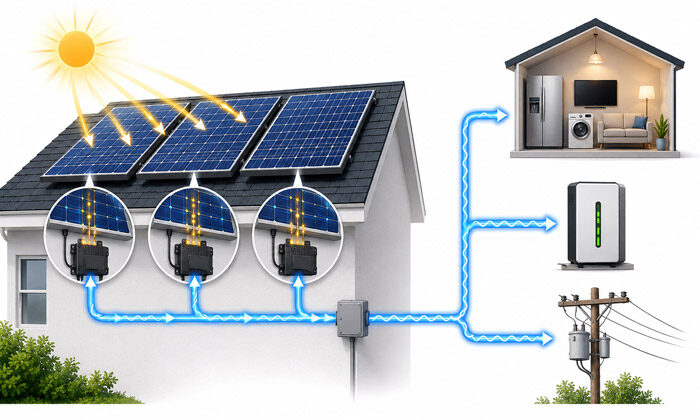
In an AC solar panel system, this conversion happens directly behind each panel:
- The photovoltaic cells absorb sunlight and produce DC electricity.
- The built-in microinverter converts the DC electricity into AC electricity.
- The AC output from each panel is combined through the system’s electrical wiring.
- The electricity powers appliances, charges a compatible battery system, or flows into the utility grid.
Because every panel has its own microinverter, the performance of one panel has less effect on the rest of the array.
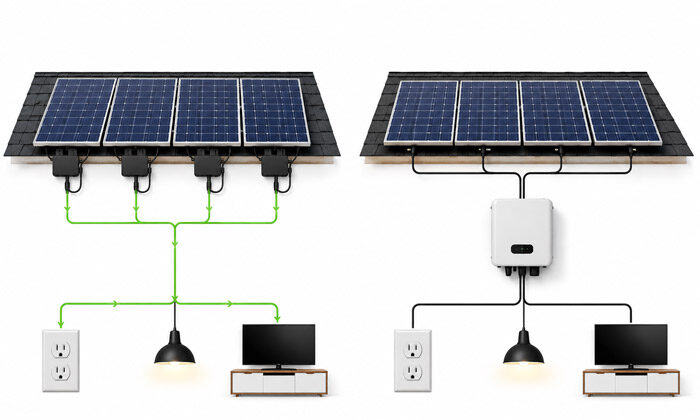
| Feature |
AC Solar Panels |
Conventional DC Solar Panels |
| Power output from each module |
AC electricity |
DC electricity |
| Inverter configuration |
One microinverter per panel |
Usually one central or string inverter |
| Performance under partial shading |
Stronger individual-panel performance |
Shading may reduce output across a string |
| Panel-level monitoring |
Usually available |
Depends on the inverter and optimizer setup |
| Installation design |
Modular and flexible |
Requires careful string design |
| Expansion |
Relatively easy |
May require inverter or string modifications |
| Initial equipment cost |
Usually higher |
Usually lower |
| Number of electronic components on the roof |
Higher |
Lower |
| Single point of inverter failure |
No central inverter failure point |
Central inverter failure can stop major system output |
Better Performance in Partial Shade
In a traditional string inverter system, panels are connected in groups. A shaded, dirty, damaged, or poorly oriented panel can reduce the output of other panels in the same string.
AC solar panels operate independently. If one panel receives less sunlight, the remaining panels can continue producing electricity according to their own conditions. This makes AC modules useful for roofs affected by trees, chimneys, vents, or different roof angles.
Panel-Level Monitoring
Most AC panel systems support individual module monitoring. System owners and installers can view the output of each panel rather than seeing only the total production of the array.
Panel-level data makes it easier to identify shading, dirt accumulation, wiring problems, or equipment faults.
Flexible System Design
AC solar panels do not require panels to be grouped into carefully matched DC strings. Panels can often be installed on different roof sections with different orientations and sunlight conditions.
This flexibility is valuable for residential roofs with limited or irregular installation space.
Easier Future Expansion
Additional AC modules can often be added without replacing a central inverter, provided the electrical system and manufacturer requirements allow the expansion.
This modular design is useful for homeowners who want to begin with a smaller system and increase its capacity later.
Reduced High-Voltage DC Wiring
Because DC electricity is converted at the panel, the system primarily carries AC electricity after conversion. This reduces the amount of high-voltage DC wiring across the building.
AC systems must still be installed according to local electrical and fire-safety requirements, but panel-level conversion can simplify certain safety functions and shutdown procedures.
Higher Initial Cost
AC solar panels generally cost more per module because each panel includes a microinverter and additional electronics. The higher equipment cost may be partly offset by simpler system design, detailed monitoring, and improved production in difficult roof conditions.
Roof-Based Electronics
Microinverters are installed beneath the panels, where they are exposed to heat, moisture, and changing weather conditions. Quality products are designed for outdoor operation, but accessing a failed microinverter usually requires rooftop work and temporary panel removal.
Compatibility Requirements
An AC solar panel combines components that must operate together. Replacing the panel or microinverter in the future may require compatible equipment from the original manufacturer or an approved alternative.
Installers should verify warranty conditions, monitoring compatibility, grid requirements, and replacement options before selecting a system.
Not Automatically Compatible With Every Battery
Many battery systems store electricity as DC, while AC solar panels produce usable AC output after panel-level conversion. Connecting AC panels to battery storage may require an AC-coupled battery system or additional conversion equipment.
Battery compatibility should be evaluated as part of the complete system design rather than after installation.
AC solar panels are particularly suitable for:
- Residential roofs with partial shading
- Roofs with multiple slopes or orientations
- Small and medium-sized solar installations
- Projects requiring panel-level monitoring
- Systems likely to be expanded later
- Installations where avoiding a single central inverter is a priority
For large, open commercial or utility-scale installations with uniform sunlight, conventional string or central inverter systems may offer lower equipment costs and easier centralized maintenance.
AC solar panels are not necessarily more efficient at converting sunlight into electricity at the solar-cell level. Their main advantage is improved system-level energy production under real-world conditions.
When every panel receives equal sunlight and operates normally, a well-designed string inverter system may perform similarly. However, when panels experience different shading, orientations, temperatures, or levels of dirt, individual microinverters can help prevent one weak panel from reducing the performance of the entire group.
The most important comparison is therefore not only the rated panel efficiency, but also the expected annual energy production of the complete system.
Do AC solar panels work during a power outage?
Most grid-connected AC solar panels automatically shut down during a power outage to protect utility workers and electrical equipment.
Backup power requires a compatible battery, transfer switch, and system controller designed for island operation.
How long do AC solar panels last?
The photovoltaic module may continue operating for 25 to 30 years or longer, while the integrated microinverter has its own expected service life and warranty.
Product quality, installation conditions, temperature, and maintenance can affect long-term performance.
Do AC solar panels require a special electrical panel?
Not always, but the property’s main electrical panel must have sufficient capacity for the solar connection.
An installer may recommend a panel upgrade, load-side connection, supply-side connection, or dedicated solar subpanel based on local electrical codes.
Can AC solar panels participate in net metering?
Yes, grid-connected AC solar panels can generally support net metering where the program is available.
A bidirectional utility meter records electricity imported from the grid and excess solar electricity exported from the property.
What maintenance do AC solar panels require?
AC solar panels usually require minimal routine maintenance.
Owners should keep the modules reasonably clean, monitor panel-level production, inspect for physical damage, and arrange professional testing when a panel reports unusually low output or repeated faults.