A PVT solar panel, also called a photovoltaic-thermal panel or hybrid solar collector, is a solar technology that produces both electricity and usable heat from the same surface. In a standard photovoltaic (PV) panel, only part of the incoming solar energy is converted into electricity, while a large share becomes heat. A PVT system is designed to capture that heat instead of letting it dissipate, so the same collector area can deliver two forms of energy at once. Authoritative technical sources from the International Energy Agency Solar Heating and Cooling Programme (IEA SHC), NREL, and Fraunhofer ISE all describe PVT as a combined electricity-and-heat technology built by coupling PV cells with a thermal collector or heat exchanger.
That dual output is what makes PVT different from conventional solar hardware. A normal PV array is optimized for electrical generation, while a solar thermal collector is optimized for heating water or air. PVT sits in between: it is a hybrid solution intended for buildings or systems that need both power and low- to medium-temperature heat. This is especially valuable where roof or façade area is limited, because the same footprint can contribute to domestic hot water, space heating, ventilation air preheating, heat pump support, or some industrial thermal uses while also generating electricity.
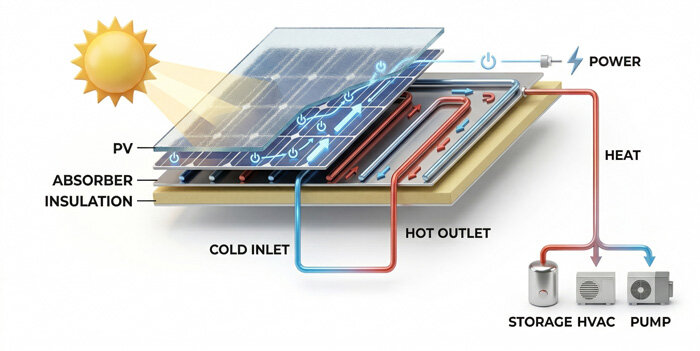
The operating principle is straightforward. Sunlight reaches the PV cells on the front of the module. Part of that solar radiation becomes electricity, but the cells also heat up. As PV cell temperature rises, electrical efficiency tends to fall, which is one reason conventional PV modules perform less efficiently when hot. In a PVT panel, a thermal absorber mounted behind or integrated with the PV layer removes part of that heat by circulating a fluid—typically water, a water-glycol mixture, air, or in some specialized systems another heat-transfer medium. That recovered heat can then be sent to a storage tank, a building HVAC loop, or a heat pump system.
This arrangement creates two benefits at once. First, the system harvests thermal energy that would otherwise be wasted. Second, cooling the PV cells can help the electrical side operate more effectively than it would under hotter conditions. The IEA SHC material notes that PVT design always involves a trade-off between prioritizing heat or electricity, while NREL emphasizes that removing heat from the back of the PV panel can improve cell operation and turn more of the incoming solar energy into useful output.
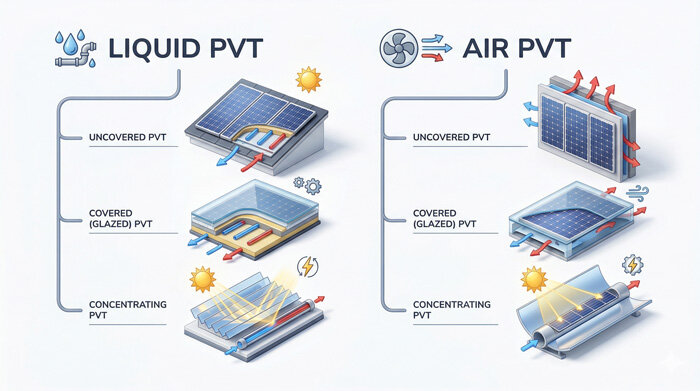
PVT technology is not a single product design. According to IEA SHC, commercial and near-commercial PVT collectors can be classified first by heat-transfer fluid and then by construction type. The two most basic fluid categories are liquid PVT and air PVT. In addition, systems may be uncovered, covered (glazed), or concentrating. Each variant serves different temperature ranges and building needs.
Liquid PVT collectors usually circulate water, glycol, or a similar fluid behind the PV cells. These systems are especially suitable when the thermal output will be stored in a tank or used in hydronic heating loops. Air PVT collectors, by contrast, use air as the heat-transfer medium and are often attractive for ventilation preheating, agricultural drying, or applications in places where water handling is less desirable. Covered or glazed PVT collectors add an extra glazing layer to reduce heat loss and achieve higher fluid temperatures, but that added optical layer can also lower electrical output slightly because of additional reflection losses. Concentrating PVT systems use optics to focus sunlight and are more specialized, usually requiring tighter control and sometimes solar tracking.
|
PVT type
|
Heat-transfer medium
|
Main strength
|
Main limitation
|
Typical uses
|
|
Liquid PVT
|
Water, glycol, or similar fluid
|
Good for storing and using heat in tanks and hydronic systems
|
More plumbing complexity than air systems
|
Domestic hot water, space heating, heat pump support
|
|
Air PVT
|
Air
|
Simpler thermal infrastructure and useful for ventilation-related applications
|
Air has lower heat capacity than liquids, so performance gains can be more limited
|
Ventilation air preheating, space heating, crop drying
|
|
Uncovered PVT
|
Usually liquid, sometimes air
|
Works well at low temperatures and can pair effectively with heat pumps
|
Lower attainable temperatures than covered systems
|
Heat pump source, pool heating, low-temperature applications
|
|
Covered / Glazed PVT
|
Usually liquid
|
Higher thermal efficiency and higher operating temperatures
|
Extra glazing can slightly reduce electrical output
|
DHW, solar cooling support, medium-temperature uses
|
|
Concentrating PVT (CPVT)
|
Specialized
|
Better suited to higher-temperature applications and high-performance cells
|
More complex optics, control, and often tracking requirements
|
Specialized industrial/process applications
|
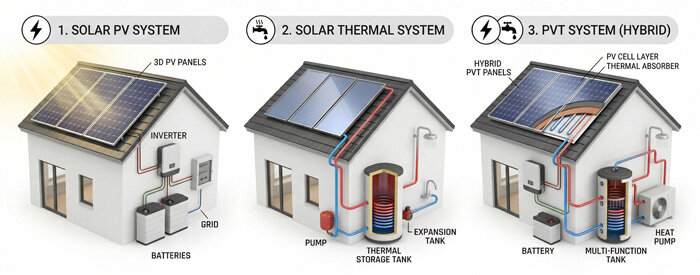
The biggest advantage of PVT is better use of limited surface area. On many buildings, roof space is the main constraint. If the owner needs both electricity and hot water, installing separate PV modules and separate solar thermal collectors may not be the best use of space. A PVT array can consolidate these functions into a single building element. Fraunhofer ISE explicitly highlights that combined photovoltaic-thermal collectors generate electricity and heat on one and the same surface, while NREL notes that electricity and water or air heating can be produced within the same footprint.
Another important advantage is system integration. PVT works particularly well in buildings with year-round or regular low-temperature heat demand. That includes multifamily housing, hotels, hospitals, sports facilities, and buildings using heat pumps or radiant floor heating. IEA SHC identifies applications such as domestic and industrial space heating, water heating, water distillation, cooling, food processing, and heat-pump-assisted systems. The same source also notes that low-temperature applications such as swimming pools, underfloor heating, and heat pump integration are especially relevant for some PVT designs.

PVT can also improve system-level energy performance. Fraunhofer ISE notes that standard PV modules typically convert roughly 15% to 20% of sunlight into electricity, leaving substantial residual energy as heat. IEA SHC likewise indicates that, depending on cell efficiency and collector design, a PVT system may generate multiple units of thermal energy for every unit of electrical energy. That does not mean PVT is universally superior to separate PV plus thermal collectors in every project, but it does explain why the technology is attractive in integrated building-energy strategies.
PVT is not a magic upgrade for every solar project. Its main challenge is that it must serve two masters at once. If a system is optimized for cooler PV cells and stronger electrical output, the recovered heat may be at a relatively low temperature. If the system is optimized to produce hotter thermal output, the PV cells may operate less favorably or the glazing and thermal design may reduce electrical performance. IEA SHC makes this trade-off explicit: collector design determines operating temperature range, application fit, and whether heat or electricity is prioritized.
Cost and design complexity are also real considerations. A PVT installation generally requires more detailed engineering than a simple rooftop PV system, especially if storage tanks, pumps, controls, or heat pump integration are involved. NREL’s demonstration report describes PVT as an early commercial technology and stresses that project success depends heavily on proper design, commissioning, and matching the system to a building with suitable thermal demand. In other words, PVT makes the most sense when the heat will actually be used. Without a dependable heat load, the “thermal” half of the hybrid system loses much of its value.
|
Feature
|
Conventional PV
|
Solar Thermal Collector
|
PVT Solar Panel
|
|
Main output
|
Electricity
|
Heat
|
Electricity + heat
|
|
Best when you need
|
Power only
|
Hot water / thermal energy only
|
Both power and thermal energy
|
|
Roof-space efficiency
|
Good
|
Good
|
Often strongest where both outputs are needed from limited area
|
|
Thermal recovery
|
No
|
Yes
|
Yes
|
|
Cooling effect on PV cells
|
Not applicable
|
Not applicable
|
Yes, in many designs
|
|
System complexity
|
Lower
|
Moderate
|
Usually higher
|
|
Best-fit projects
|
Homes and buildings focused on power generation
|
DHW-heavy or thermal-heavy buildings
|
Buildings with simultaneous electrical and low/medium-temperature thermal demand
|
The strongest use case for PVT is not simply “a building with sunshine.” It is “a building with sunshine and a regular need for useful heat.” Domestic hot water systems are a classic example. NREL’s federal-building demonstration focused on using thermal collectors attached to the backs of PV modules to preheat domestic hot water. IEA SHC also identifies domestic hot water and space heating as central applications, while noting that collector choice depends on required operating temperatures.
Heat pump systems are another particularly promising fit. IEA SHC explains that uncovered and low-temperature PVT collectors can serve as effective heat sources for heat pumps, and that integration can enhance overall system utilization. This matters because modern building decarbonization increasingly depends on electrification plus low-temperature heating distribution. In that context, PVT can act as a bridge technology that supports both electrical production and thermal input in one integrated energy system.
PVT also deserves attention in architecture and envelope design. Fraunhofer ISE points to façade- and roof-integrated solutions that combine energy generation with building integration. That makes PVT interesting not only for engineering reasons but also for design-led projects where the building envelope itself is expected to contribute actively to heating and power performance.
The best answer is: it depends on the job. If your only goal is to generate electricity at the lowest practical complexity, standard PV is usually the simpler choice. If your main goal is hot water or solar heat, a dedicated solar thermal collector may be more direct. But if you need both electricity and thermal energy, and your available roof or façade area is limited, PVT can be an elegant and highly efficient use of space. That is exactly why research institutions and energy agencies continue to study and develop it.
FAQs
Do PVT solar panels still work well in cold or cloudy climates?
Yes. Some PVT configurations are especially valuable in low-temperature operation.
Uncovered PVT collectors can operate effectively near or even below ambient temperature and may serve as a heat source for heat pumps, including periods without direct sunshine by harvesting both solar and ambient heat.
Cold or cloudy climates do not automatically rule out PVT. The more important question is whether the system is properly designed for the building’s temperature levels, storage strategy, and winter heat demand.
Can a PVT system be retrofitted into an existing building or heating system?
Often yes, but retrofit success depends heavily on the existing heating architecture.
PVT-plus-heat-pump systems can be a practical retrofit pathway, especially when the building already has—or can be adapted to—low-temperature heating, thermal storage, and coordinated controls.
If the existing system depends on very high water temperatures, the retrofit becomes more difficult and may require hybrid backup or broader system redesign.
What maintenance does a PVT system require compared with standard PV?
A PVT system generally requires more maintenance attention than standard PV because it combines an electrical module with a thermal loop.
In addition to the PV surface, the system may include pumps, valves, piping, heat exchangers, storage tanks, controls, and in some climates antifreeze fluid or freeze-protection hardware.
As a result, the overall system is maintained more like a small solar-thermal plant than a conventional PV array.
What certifications or technical data should buyers ask for before choosing a PVT product?
Buyers should request independently verified test data rather than relying only on marketing claims.
Important documentation can include thermal test results under standards such as ISO 9806:2017, Solar Keymark certification where applicable, electrical performance under realistic operating conditions, reliability testing, and evidence of how the product handles PVT-specific challenges such as mechanical loads and high-temperature operation.
In practice, long-term reliability and documented lifetime performance are often just as important as headline efficiency figures.
What are the biggest technical risks in PVT systems, and how are they managed?
The main engineering risks are usually related to overall system integration rather than the collector alone.
Key concerns include overheating, stagnation, freeze protection, and control coordination.
Good system design manages these risks through appropriate hydraulic layout, thermal protection strategies, antifreeze or freeze-protection measures where needed, and control logic that protects both the PV cells and the thermal circuit.
The real quality marker is therefore not just the collector itself, but how well the entire hydraulic and control system has been engineered.